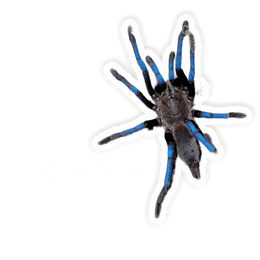
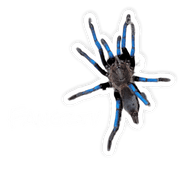


Thalerommata yukpa Cesar Gold Stripe .5''
- In stock, ready to ship
- Out of stock
- Free Shipping On Orders $300+
- Live Arrival Guarantee
Scientific Name: Thalerommata yukpa
Common Name: Cesar Gold Stripe
Classification: New World Terrestrial
Endemic Location: Colombia, Venezuela
Adult Size: Approximately 2 inches
Lifespan: 2-4 years for males and 10-12 years for females.
Interesting facts about this species: Thalerommata yukpa is an incredibly rare, obscure New World tarantula that was discovered in the Cesar region of Colombia , named after the Yukpa people who believed the world was created with the assistance of a spider. Known in some ancestral narratives as the "sun-spider," this entity is a central figure of growth, weaving, and cosmic design, helping to shape the foundations of their universe.
This spider is VERY fast, arguably one of the fastest terrestrial tarantulas known. It's not known to be defensive rather it uses its speed and willingness to make small leaps to avoid predators. They are moderate to heavy webbers and I have witnessed a female or two that was long established to make a trap door-esq covering , although the majority of mine make standard burrows and tunnels.
I have produced this species on two different occasions and to my knowledge I'm the only one in the USA to have produced them as well as continuing to produce them after the fact. Availability wise this is a very rare spider in the USA due to those two factors.
They have great appetites and are easy to care for and are very hardy. I keep mine around room temperature 70-74 with moistened substrate around 4-6 inches. The spiderlings will scavange pre-killed prey readily and the adults can eat up to 1/2'' sized prey. They also grow quite rapidly with the males maturing within around 2+ years.
Shipments go out Fedex Overnight with Live arrival Guarantee. For more information on Shipping please see: Shipping FAQ
Earn Reward Points for each purchase and cash them in for amazing offers! Account Required.
General Spider Care
Housing
For housing its best to choose an enclosure that fits your tarantula well. For terrestrial spiders something short and wide, and arboreal spiders something tall and narrow. Usually smaller is better than larger when choosing between two sizes. Use Eco Earth coco coir or other organic bedding like potting soil mixed with clay or sand. You can also use sphagnum moss and leaf litter to decorate.
Water
Spiders get most of the water they need from they prey they consume , but they will also drink from shallow water dishes. For small slings use thin water bottle cap sized dishes , moving up to 5oz sized bowls for adults.
Food
Spiders will eat almost anything they can over power. Crickets , roaches, meal worms, super worms , you name it. I feed my tarantulas one to two prey items the size of their abdomen about once a week. You will see certain species have faster or slower metabolisms. Adjust accordingly if your spider starts to get chunky. They can often go long periods without eating as well which is completely normal. Pick out or remove any food that has been eaten or not after about 24 hours.
Molting
As your tarantula grows it will molt out of its old skin. They do this by flipping on their back and pushing out of the old exoskeleton. It's important to leave the tarantula alone during this period which may take many hours. Pause and resume feeding about 1 week later after it has hardened up.
Tools
There are a variety of tools to keep on hand but the most important tend to be a pair of long hemostats (tweezers) usually around 10''. I also like to keep an empty deli-cup around in case I ever need it. A spray bottle can also be used to help more tropical species, but be aware over -spraying can cause some issues. It's best to keep the substrate semi-damp rather than spraying a lot.